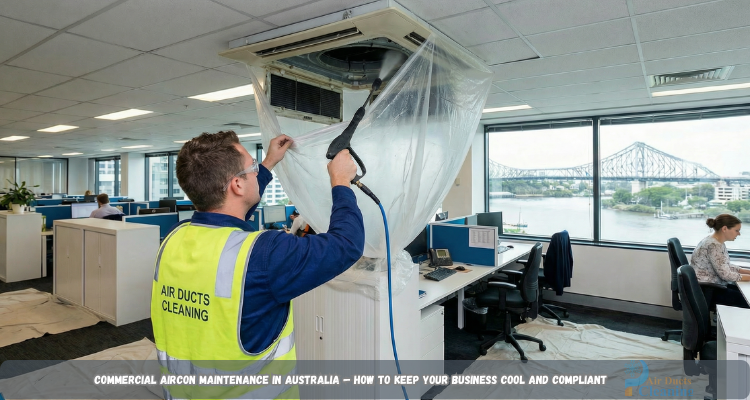
If you run a business in Brisbane or Sydney, your commercial air conditioning system is one of the most important pieces of equipment in your building.
It keeps your staff productive, your customers comfortable, and your indoor air quality at a standard that Australian law actually requires. But unlike residential aircon, commercial systems come with a set of legal obligations that many business owners and facility managers don’t fully understand — until something goes wrong.
This guide covers everything you need to know about commercial aircon maintenance in Australia. How often your system needs servicing, what the law requires, what a proper service includes, and what happens when maintenance gets skipped. Whether you manage an office in the Sydney CBD, a restaurant in Brisbane’s inner south, or a warehouse in Western Sydney, this guide is written for you.
Why Commercial Aircon Maintenance Is Different From Residential
Most business owners assume commercial aircon maintenance is just a bigger version of what you do at home. It isn’t — and understanding that difference matters.
The Scale and Complexity Are Completely Different
Commercial systems run longer hours, serve more people, and move significantly more air than any residential unit. A typical office in Sydney’s CBD or a busy café in Brisbane’s Fortitude Valley might run their system for 10 to 12 hours a day, six or seven days a week.
That kind of workload means filters clog faster, coils accumulate dirt more quickly, and components wear down at a rate that a twice-yearly service schedule simply cannot keep up with. Commercial systems also include equipment types — air handling units, cooling towers, fan coil units, and VRF systems — that require specialised knowledge and tools to maintain properly.
Your Legal Obligations Are Significant
This is the part that catches a lot of Brisbane and Sydney business owners off guard. Commercial aircon maintenance in Australia is not optional — it is a legal requirement governed by Australian Standard AS/NZS 3666, the Work Health and Safety Act, and various state-level regulations.
Failure to comply with these standards can result in fines, litigation, and in serious cases involving Legionella bacteria outbreaks, criminal liability. Sydney has experienced documented Legionnaires’ disease outbreaks linked to poorly maintained commercial cooling towers — a stark reminder that this is not a theoretical risk.
What Australian Law Actually Requires
Understanding your compliance obligations is the foundation of any commercial aircon maintenance program in Brisbane or Sydney.
AS/NZS 3666 — The Key Australian Standard
AS/NZS 3666 is the primary Australian standard governing commercial air handling and water systems. It exists specifically to minimise microbial growth — including Legionella bacteria — in commercial buildings.
The standard has four parts. Part 1 covers design, installation, and commissioning. Part 2 covers operation and maintenance, which is what most facility managers need to focus on day to day. Part 3 covers performance-based maintenance of cooling water systems. Part 4 covers performance-based maintenance of air handling systems including ducts and components.
Under AS/NZS 3666 Part 2, your commercial HVAC system must have a formal maintenance program in place. This is not a guideline — it is a prescriptive requirement with specific inspection and cleaning schedules attached to it.
The Five Areas That Must Be Maintained
According to AS/NZS 3666.2, five specific parts of your commercial air conditioning system must be included in any maintenance program.
Outdoor air intakes and exhausts must be inspected monthly. Air filters must also be inspected monthly and cleaned or replaced when necessary. Humidifiers require monthly inspection.
Evaporative air cooling equipment — including all internal parts — must be inspected every three months. Ductwork and air distribution components each carry their own separate inspection timelines depending on the component type, with annual duct inspection required as a minimum under the standard.
The Work Health and Safety Act
Under the Work Health and Safety Act — which applies in both Queensland and New South Wales — a person conducting a business or undertaking has a legal responsibility to provide and maintain a safe working environment. This explicitly includes indoor air quality, temperature management, and the maintenance of any plant or structure affecting worker health.
In practical terms, if your commercial aircon system is producing poor indoor air quality because maintenance has been neglected, you are potentially in breach of your WHS obligations. For Brisbane and Sydney businesses with staff on site, this is a genuine legal exposure that routine maintenance directly protects against.
Your Risk Management Plan
For higher-risk commercial systems — particularly those with cooling towers, which are common in larger Sydney and Brisbane commercial buildings — a formal Risk Management Plan is required. This document outlines the specific strategies your building uses to control microbial growth, the maintenance schedule, testing procedures, and who is responsible for each task.
Building managers must also have a formal, enforceable maintenance agreement with their contractor that covers the timing and format of maintenance reports, including those related to Legionella monitoring consistent with AS/NZS 3896.
What a Proper Commercial Aircon Service Includes
Knowing what a legitimate commercial aircon service covers helps you hold your contractor accountable and make sure you’re getting genuine compliance value.
1. Filter and Coil Maintenance
Filter cleaning and replacement is the most frequent task in any commercial maintenance program. Dirty filters choke airflow, force the system to work harder, and push contaminated air through your building. For most commercial systems in Brisbane and Sydney, filter inspection is required monthly — not quarterly or annually.
Coil cleaning — both evaporator and condenser coils — removes the biological and dust buildup that stops your system from transferring heat efficiently. Dirty coils are one of the most common hidden causes of rising energy bills in commercial buildings. A unit working harder than it needs to because of fouled coils is drawing more electricity every single hour it runs.
2. Refrigerant Check and Electrical Inspection
A refrigerant check confirms your system is operating at the correct gas charge. Low refrigerant almost always indicates a leak rather than simple depletion — and refrigerant leaks in commercial systems must be addressed promptly under the Ozone Protection and Synthetic Greenhouse Gas Management Act. Any technician handling refrigerants must hold a valid ARC Tick licence — this is a legal requirement across Australia.
Electrical inspection covers all wiring connections, capacitors, contactors, and safety switches throughout the system. This is especially important in older Brisbane and Sydney commercial buildings where electrical infrastructure may already be under load stress from the building’s age.
3. Drain Line Clearing and Duct Inspection
Blocked drain lines cause water damage to ceilings, walls, and flooring in commercial buildings — a disruptive and expensive problem that a scheduled service prevents. Annual duct inspection checks for duct leakage, contamination, and any buildup that reduces system efficiency and indoor air quality.
4. Service Logbook and Reporting
Every commercial aircon service in Australia should be documented in a maintenance logbook. This is not just good practice — it is a compliance requirement under AS/NZS 3666 and is often required by insurance providers and landlord agreements. Your service reports should include what was inspected, what was found, what was done, and any recommendations for follow-up action.
How Often Should You Service Your Commercial Aircon in Brisbane and Sydney?
The right frequency depends on your system type, your building’s use, and what AS/NZS 3666 specifies for each component. Here is a practical guide for Brisbane and Sydney businesses.
1. Monthly Inspections
Outdoor air intakes, air filters, and humidifiers require monthly inspection under AS/NZS 3666.2. For high-traffic Brisbane businesses — restaurants, retail stores, medical centres, childcare centres — monthly filter checks are especially important because the volume of people moving through the space accelerates contamination.
2. Quarterly Servicing
Evaporative air cooling equipment requires full inspection every three months. For most commercial split systems and ducted systems operating under heavy load in Brisbane and Sydney’s warm climates, a quarterly service visit makes practical sense — catching buildup before it affects performance, efficiency, or compliance.
3. Bi-Annual and Annual Servicing
A full bi-annual service — before summer and before winter — is the baseline for commercial systems operating in moderate conditions. Annual duct inspection is required under AS/NZS 3666 as a minimum. An independent compliance audit of your Risk Management Plan is required annually for high-risk systems and every two years for lower-risk installations.
The Real Cost of Skipping Commercial Aircon Maintenance
This is where a lot of Brisbane and Sydney businesses learn an expensive lesson — usually at the worst possible time.
1. System Breakdowns and Emergency Repair Costs
A commercial aircon breakdown during a Brisbane summer or a Sydney heatwave does not just cause discomfort.
It disrupts business operations, sends customers elsewhere, and triggers emergency call-out rates that are significantly higher than scheduled maintenance costs. In restaurants and retail environments, a breakdown during trading hours is a direct hit to revenue.
The chain of failure that leads to a breakdown is always the same. Dirty filters restrict airflow. Restricted airflow overworks the coils. Overworked coils stress the compressor. A stressed compressor fails prematurely. And commercial compressor replacement is a major capital expense that preventive maintenance consistently and reliably avoids.
2. Rising Energy Bills
A poorly maintained commercial aircon system draws significantly more electricity to deliver the same cooling result as a well-maintained one. For a 25 kW light-commercial system running 8 hours a day across a 250-day business year in South-East Queensland — where commercial electricity rates sit around $0.27 per kilowatt-hour — the cost difference between an efficient and an inefficient system adds up to real money every quarter.
Regular commercial aircon maintenance directly supports your NABERS energy rating, which matters for Sydney CBD office buildings and any commercial property targeting Green Star compliance.
3. Legal and Insurance Consequences
Skipping commercial aircon maintenance in Australia is not just operationally risky — it is legally exposed. Non-compliance with AS/NZS 3666 can result in fines and litigation.
Many commercial insurance policies and lease agreements require an annual certificate of cleaning. Without documented maintenance records, a claim related to air quality, water damage, or a Legionella incident could be rejected by your insurer entirely.
Choosing the Right Commercial Aircon Maintenance Provider in Brisbane or Sydney
With many providers operating across Brisbane and Sydney, the quality of commercial aircon maintenance varies significantly. Here is how to choose a provider you can genuinely trust.
Check Licences and Accreditations
Any technician handling refrigerants must hold a valid ARC Tick licence. Electrical work on your system requires a current state electrical contractor licence — in Queensland, this is issued by the Electrical Safety Office; in New South Wales, by Service NSW. Always ask for both credentials before engaging a provider.
Look for providers familiar with AS/NZS 3666 compliance requirements specifically. A technician who cannot speak confidently about the standard is not the right fit for a commercial maintenance program.
Demand a Written Maintenance Agreement
A professional commercial aircon maintenance provider gives you a written service agreement that specifies exactly what is included at each visit, the frequency of each maintenance task, how service reports and logbook entries are handled, and what the response time is for emergency call-outs.
Avoid any provider who quotes verbally or is vague about what their commercial service covers. In a compliance-governed environment, vagueness is a liability.
Look for Local Knowledge
Brisbane and Sydney have genuinely different climate conditions that affect commercial aircon maintenance needs. Brisbane’s subtropical humidity and year-round warmth mean systems accumulate biological growth faster and require more frequent filter and coil attention.
Sydney’s coastal salt air in harbour-adjacent buildings — the CBD, North Sydney, Pyrmont — accelerates corrosion on outdoor components. A provider with genuine local experience understands these conditions and schedules maintenance accordingly — not just by the calendar but by what your specific building and system actually demand.
Frequently Asked Questions About Coomercial Aircon Service
1. How often should commercial aircon be serviced in Australia?
Under AS/NZS 3666.2, outdoor air intakes, filters, and humidifiers require monthly inspection. Evaporative cooling equipment requires quarterly inspection. Ductwork requires annual inspection at a minimum.
For most commercial systems in Brisbane and Sydney operating under heavy load, quarterly full-service visits supported by monthly filter checks represent best practice.
2. What is AS/NZS 3666 and why does it matter for my business?
AS/NZS 3666 is the Australian Standard governing microbial control in commercial air handling and water systems. It sets the legal framework for how commercial aircon systems must be maintained in Australia.
Non-compliance can result in fines, litigation, and in serious cases involving Legionella, criminal liability. It applies to virtually all commercial buildings in Brisbane, Sydney, and across Australia.
3. Who is responsible for commercial aircon maintenance in a leased building?
This depends on the terms of your lease agreement. In most commercial leases, the tenant is responsible for routine maintenance and the building owner is responsible for major capital repairs.
Your lease should specify this clearly. If it doesn’t, get legal advice before assuming either way — the financial and compliance consequences of getting this wrong are significant.
4. What happens if I don’t maintain my commercial aircon in Australia?
Non-compliance with AS/NZS 3666 can result in regulatory fines and legal liability. Insurance claims related to air quality incidents or water damage may be rejected without maintenance records.
Legionella outbreaks linked to poorly maintained systems have resulted in serious legal consequences for building managers in Australia. Beyond compliance, neglected systems consume more energy, break down more often, and fail earlier than well-maintained ones.
5. Do I need a licensed technician for commercial aircon maintenance?
Yes. Any work involving refrigerants requires a valid ARC Tick licence under Australian federal law. Electrical work requires a current state electrical contractor licence.
Never engage an unlicensed provider for commercial aircon maintenance — the compliance, safety, and liability risks are not worth any perceived cost saving.
6. What should a commercial aircon maintenance contract include?
A proper commercial maintenance contract should specify the frequency and scope of each maintenance task, the qualifications of the technicians performing the work, how service reports and maintenance logbook entries are documented, response times for emergency call-outs, and how compliance with AS/NZS 3666 is verified and reported. Any contract that is vague on these points should be renegotiated before signing.
The Bottom Line
Commercial aircon maintenance in Brisbane and Sydney is not something you schedule when it is convenient — it is a legal obligation, a business continuity strategy, and a financial investment that pays for itself every time a breakdown doesn’t happen.
Start with understanding your obligations under AS/NZS 3666 and your WHS responsibilities. Build a written maintenance program with a licensed, experienced local provider. Document everything in your service logbook.
And treat your commercial aircon system as the business-critical asset it genuinely is — because when it fails in the middle of a Brisbane summer or a Sydney heatwave, the cost of having neglected it will always be higher than the cost of looking after it properly.